HOLOTROPIC TRAINING

A path of one’s own process and learning to work with expanded states of consciousness

Two levels of training

WHAT CAN YOU LEARN IN THE HOLOTROPIC TRAINING?

Holotropic training is not only preparation for facilitating workshops, but also a multidimensional path of personal and professional development. Whether you want to facilitate sessions, enrich your therapeutic practice, or go through your own process of transformation — the training opens the door to working with expanded states of consciousness.

Deep transformation

OWN PROCESS

During the training, you go through tens of Holotropic Breathwork sessions that gradually reveal deeper layers of the psyche and emotions. It is an intensive path of healing, leading to greater self-awareness, the release of old patterns, and the discovery of your inner resources.

The art of accompanying

WORKING WITH OTHERS IN EXPANDED STATES OF CONSCIOUSNESS

The training develops unique skills in facilitating others through deep psychological and spiritual processes. You learn how to create a safe space, work non-directively, and support participants through the most intense experiences of consciousness.

Psychology and spirituality

A BRIDGE BETWEEN TWO WORLDS

Holotropic Training brings together the precision of modern psychotherapy with the wisdom of shamanic traditions and spiritual work. The result is a unique approach that integrates both psychological and transpersonal dimensions of human experience.

Process of learning

TRAINING FORMAT

The training unfolds as a multi-year process combining intensive practice, theory, and personal experience. Step by step, you develop the skills of a facilitator while working through your own limitations and discovering new ways of working with others.

WHAT CAN YOU LEARN IN HOLOTROPIC TRAINING?

Holotropic training is not only preparation for facilitating workshops, but also a multidimensional path of personal and professional development. Whether you want to facilitate sessions, enrich your therapeutic practice, or go through your own process of transformation — the training opens the door to working with expanded states of consciousness.

OWN PROCESS

During the training, you go through dozens of Holotropic Breathwork sessions that gradually reveal deeper layers of the psyche and emotions. It is an intensive path of healing, leading to greater self-awareness, the release of old patterns, and the discovery of your inner resources.

WORKING WITH OTHERS IN EXPANDED STATES OF CONSCIOUSNESS Slogan:

The training develops unique skills in facilitating others through deep psychological and spiritual processes. You learn how to create a safe space, work non-directively, and support participants through the most intense experiences of consciousness.

A BRIDGE BETWEEN TWO WORLDS

Holotropic training brings together the precision of modern psychotherapy with the wisdom of shamanic traditions and spiritual work. The result is a unique approach that integrates both psychological and transpersonal dimensions of human experience.

TRAINING FORMAT

The training unfolds as a multi-year process combining intensive practice, theory, and personal experience. Step by step, you develop the skills of a facilitator while working through your own limitations and discovering new ways of working with others.

What can you learn in holotropic training?

On a practical level, the well-known training developed by Grofs, prepares participants to facilitate Holotropic Breathwork workshops and to work within the transpersonal paradigm. 

At the same time, it is worth stating clearly that many people who begin this training do not start with a definite plan to lead their own workshops. Quite often, they come to the first module for very different reasons.

MOTIVATIONS TO BEGIN THE TRAINING

A CALL TO WORK AND SHARE EXPERIENCE

There is a group of participants who from the very beginning intend to facilitate breathwork after completing the training. This is rarely for financial reasons, since in most countries Holotropic Breathwork is still not a widely popular method and it is difficult to find specific job offers for facilitators. Some people simply fall so deeply in love with holotropic work that from their very first encounter with the method they feel a calling to enter the training and to work in this way. Others, after working through their own major traumas and opening to a more sensitive and fulfilling life during their personal holotropic sessions, feel a desire to give something back and pass this energy on into the world, not necessarily making it their main professional activity.

INTEGRATION OF A NEW PERSPECTIVE INTO THERAPEUTIC PRACTICE

At the same time, a significant number of people choose education in the holotropic paradigm in order to enrich their existing professional practice, such as classical psychotherapy, hypnotherapy, or therapeutic massage, with a different perspective and new tools. Some attend only selected modules that are of particular interest to them. It is also worth noting the growing popularity of holotropic tools within various forms of legal psychedelic therapy in the West.

PERSONAL TRANSFORMATION AND ACCOMPANYING OTHERS

There is also a third group, perhaps the largest one, who join the training for more personal reasons. Some of them later decide during the course of the training that they would like to facilitate breathwork. Many people want both to go through their own healing process and to learn how to accompany others in non-ordinary states of consciousness and in difficult moments. This skill can be used in many different contexts, even in more conventional professional settings or within the family.

TWO LEVELS OF THE TRAINING

Stanislav Grof designed his training on two parallel, interpenetrating levels.

As a bridge between traditional, long-term shamanic training and classical psychotherapy education, it draws deeply from both approaches.

This approach is grounded in several decades of Grof’s practical experience, both in psychiatric hospitals using psychedelic-assisted therapy and in institutes and workshops around the world using Holotropic Breathwork.

DEEP INNER WORK WITH YOUR OWN PROCESSES

It is inner work on one’s own processes, resembling a combination of very intensive body-oriented psychotherapy and spiritual initiations undertaken in seclusion.

A COMPREHENSIVE TRAINING PROGRAM

It is a comprehensive training program in which participants learn tools for accompanying another person in working with their emotions, personal history, and personality through a therapeutic relationship, as well as a transpersonal approach focused on the safe and professional guidance of people in expanded states of consciousness.

Own process

In a single Holotropic Breathwork session it is difficult to predict anything in advance, as the process may go in any direction and can sometimes be very gentle.

However, in order to complete the training, participants must take part in:

27

 sesssions as breathers

27

 sessions as sitters

These sessions take place in a specific environment, usually in secluded locations close to nature, within large international groups of willing participants, and are facilitated by the most experienced teachers.

With such an extensive amount of inner work, it is easy to predict that participants will confront their most active personal patterns.

WHAT CHANGES IN TRAINING PARTICIPANTS?

AWARENESS OF THEIR EMOTIONS

The vast majority of trainees significantly increase their awareness of their emotions during the training, both in everyday life and at deeper, previously unconscious levels that influence their whole lives. Through strong expression, bodily tensions are gradually released, and old emotional imprints lose their power over current reactions. Traumatic experiences from the past lessen their impact, as do destructive relational patterns such as fear of abandonment, emotional deprivation, or a sense of personal defectiveness.

RELATIONS WITH OTHERS

Through repeated holotropic experiences, in which one can always ask for support, be in close physical contact, experience non-directive facilitation, and connect with others who listen without commentary and openly share their own processes, relationships with others are repaired in a lasting way.

TRUST IN INNER HEALING MECHANISMS

A stable sense also develops that we do not need someone to rescue us. With appropriate support, we are capable of helping ourselves if we trust our inner healing mechanisms and allow ourselves to surrender to experience after proper preparation and with proper integration. Immature motivations that could later influence work with people or disturb its ethical, clean, and other-focused nature also gradually become conscious and fall away.

VARIOUS EXPERIENCES IN OWN PROCESS AND IN THE TRAINING

PERINATAL ELEMENTS

PROCESSES OF INNER DEATH AND REBIRTH

TRANSPERSONAL EXPERIENCES

SPIRITUAL EXPERIENCES

With such long and deep work, almost everyone encounters experiences mentioned above which often bring satisfying answers to existential questions and allow people to view everyday life from a much deeper perspective.

At the same time, the structure of the training, which often involves traveling to other countries, reaching remote locations, communicating in different languages, and making a significant financial investment, makes it difficult to go through the training without being firmly grounded in material reality.

Working on oneself — even if its primary intention is to prepare for working with others — has a strong impact across many other areas of life.

Going through one’s own long-term healing process also has an additional dimension: it allows you to experience firsthand which elements of the holotropic system are essential and why, even if before beginning the training they might have seemed strange, unnecessary, or open to change.

CONSULTATIONS AND FIRST FACILITATIONS

CONSULTATIONS

In addition to the breathwork sessions themselves, individual consultations and, above all, personal experience in supporting groups become major sources of work on one’s own process.

FACILITATION

The first facilitation experiences under the supervision of more experienced teachers are a true treasure trove of self-knowledge and a real testing ground. In many extreme situations that arise during sessions, psychological and spiritual material emerges that rarely appears in other contexts. Supportive feedback from teachers helps participants notice their weaker areas and gradually develop them, while also learning to value and rely on their strengths.

Working with others in expanded states of consciousness


The educational aspect of the training includes both theory and practice. It is far more extensive than what can be found in Grof’s books alone.

Different ways of understanding various disorders, different approaches to working with them, methods of supporting people in psycho-spiritual crises, the inclusion of non-directive yet amplifying bodywork, and the therapeutic use of music are all introduced step by step.

There is ample time to reflect, integrate, and test these elements between modules, making it possible to absorb the extensive theoretical knowledge developed by Grof in an accessible way.

However, those who have completed the Holotropic Training consistently emphasize that it teaches something far greater than a new body of fascinating theory.

Many meta-skills develop along the way.

META-SKILLS

ATTENTIVENESS TO THE PARTICIPANT

One of these is sensitivity to the real needs and experiences of participants. Years spent in one’s own sessions increase awareness of personal processes, making it easier to distinguish them from the actual reactions, processes, and needs of others, and to approach participants with a beginner’s mind. Heightened sensory awareness during facilitation allows sustained, full presence with another person, a quality that later becomes accessible outside of workshops as well.

TRUSTING THE PROCESS

Allowing sensations, emotions, visions, memories, and experiences to flow without blocking them, and repeatedly experiencing how full trust in bodily impulses and emerging feelings leads through turbulence to resolution, makes it possible to create safe spaces for others based on deep trust in this kind of work.

HOLDING SPACE

Holding space for a group and being able to witness even the most extreme processes, including those resembling exorcisms, without judgment and with the capacity for empathic intervention when needed, is a fundamental skill practiced in the training. This in turn creates a level of safety that allows participants to trust the holotropic process, engage in intense self-exploration among people who are essentially strangers, express things they have never expressed before, and form deeply empathic relational patterns.

NON-DIRECTIVENESS

Over the years of training, a genuine understanding of non-directiveness and its meaning also develops. The fact that, despite extensive experience, we may have no idea what the content of a participant’s process is, was described by Grof as the most important and most difficult lesson of the training. Asked once about the length of the program, he explained that it takes several years of such work to understand how little one knows.

„DOING-NOT-DOING”

The impression that facilitators appear to do very little, aside from occasional spectacular bodywork, is in some ways accurate. Tav Sparks, the long-time director of Grof Transpersonal Training, described this as doing not doing, meaning not interfering with participants’ healing processes and suspending one’s judgments, desires, and ideas about helping. This seemingly simple task of doing nothing is in fact extremely difficult and is practiced over many years. Our tendency to react in our own way is very strong, and learning to restrain it is considered a core element of the training. For this reason, professionals from other fields such as therapists or coaches often find it even more challenging. Once they succeed, however, a new quality of work emerges.

”doing-not-doing” —

METHODS OF LEARNING

Knowledge gathered from various teachers

Personal work in expanded states of consciousness and their integration

Exposure to altered states in hundreds of other people

Observation of leading of workshops and group processes

Understanding the role of music in the process and learning how to design it

Learning how to enter and exit processes

Assisting in others’ processes and gradually increasing the level of difficulty in the work

Teamwork and co-facilitation of processes

Team meetings and immediate post-session feedback

Individual approach and feedback from many teachers over the years

Recognizing subtle differences in the setting

Observation of one’s own processes and those of others over many years

Observation of experienced facilitators working with participants

WIDER CONTEXT

This, along with many other subtle elements, is why indigenous shamans and Buddhist monks with many years of experience in exploring consciousness and helping others often speak very positively about holotropic work when they encounter it directly.

For this reason, many emerging legal forms of psychedelic therapy, with MAPS at the forefront, use Holotropic Training as a model and often employ breathwork facilitators as teachers of non-directive work in expanded states of consciousness.

A bridge between two worlds

TRADITIONAL MULTIYEAR SHAMANIC TRAINING

CLASSIC PSYCHOTHERAPY TRAINING


Many people have long dreamed of both navigating the depths of their own psyche in this way and learning professional work with expanded states of consciousness from a master of the field, which Stanislav Grof undoubtedly was.

For many, traditional psychotherapy training was not sufficient, as it ended at certain points or did not address certain processes, treating them as too strange or even pathological. At the same time, entering a traditional shamanic training is not easy. Finding a genuine shaman willing to teach a European, disappearing into the jungle for a year, and then integrating that knowledge into life in a European city can be extremely difficult.

People interested in working with expanded states of consciousness often have no one to learn from. Some try through trial and error based on their own experiences, sometimes with luck and sometimes at great risk. Others learn from more experienced friends.

Unfortunately, some learn from facilitators, many of whom are not trustworthy at all.

They lack knowledge about preparation, they don’t know what integration is, and their work in sessions is highly directive and based on their own biases.

Many of them:

  • lack the skills to work with trauma (and panic when a participant touches traumatic material)

  • don’t know how to work with the therapeutic relationship

  • cannot frame their approach into a coherent system

  • cannot pass that system on to others—most often because they themselves have never completed any such school or training.

As a result, those who want a thoughtful and organized educational path, and who find that traditional psychotherapy lacks space for extreme processes, spirituality, peak experiences, and the transpersonal dimension, often find in this training exactly what they have been seeking.

Training format

SUPPORTIVE APPROACH

Another interesting aspect is the format of the school itself, which inevitably evokes associations with earlier educational experiences. For some, it activates familiar roles played in school; for others, it brings up traumatic memories. At the same time, the supportive approach present even in feedback helps rework relationships with teachers, authority figures, and exams.

PERCEPTION OF EDUCATION ITSELF

The certification process and meeting successive requirements may resemble preparing for a master’s thesis defense, culminating in a two-week certification period characterized by intensive training, practical demonstrations, ongoing personal process, and an atmosphere of completion and celebration. This transforms the perception of education itself and helps heal one of the lasting legacies many of us carry from school, the sense of defectiveness and the belief that we are not capable.

INNER PATTERNS

Because many people enter the training with relational traumas that limit their range of behavior, they may initially believe they will never be able to become like the most experienced facilitators. Familiar patterns of 'I will never manage this' often arise and can be healed.

PRACTICE MAKES A MASTER

Aside from very rare cases involving persistent disregard for guidance, the training demonstrates that practice truly does make a master. Step by step, participants acquire the skills needed to work with others alongside work on their own limitations and a gradual release from unrealistic self-comparisons.

CERTIFICATION

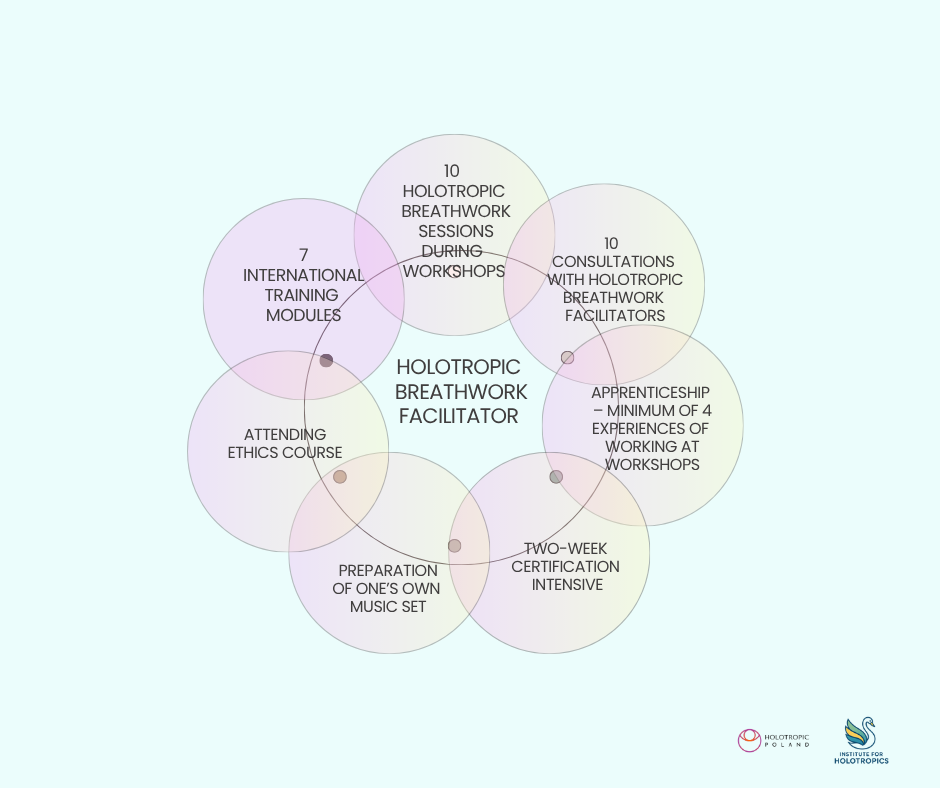
Formal requirements for entering the breathwork facilitator certification process:

“What moves me most about the holotropic training is the people — their courage, their stories, and the way something emerges from these encounters that stays with them for a long time. There is something deeply human and moving in being together in a circle, in attentive listening and sharing. And each time, I feel that these meetings also change me.” —

“I admit that during the training I met a few people toward whom, at the beginning of their journey, I held certain biases. I thought they were too traumatized and too insecure in relationships to ever be able to hold presence and facilitate the kind of powerful processes that arise in breathwork. When, a few years later, I saw them successfully and with considerable grace leading workshops in their own countries, I realized how wrong I had been. Today, I see this as further evidence of how thoughtfully Grof designed the structure of the training. I hope this text has given you a clearer sense of whether one of the modules of the holotropic training, or the full program, is right for you.” —

If you have any questions or would like to talk to us, here you will find our mobile numbers and email address

Write to us
info@holotropicpoland.pl

Let's meet
+48 886624270
+48 506736620

© 2026 Holotropic Poland. All rights reserved. We create a safe space for holotropic breathwork and the integration of experiences in expanded states of consciousness.

Explore
Drag